# Dead Battery Music (dBm) Circuits

making sounds &amp; music with digital logic gates.

# The Art of Power Starving

**or how to make dead battery music**

It has been known since the early days of electronic music that devices such as radios, amplifiers, and musical instruments can produce unusual sound artifacts during power-up and power-down. Likewise, battery-powered devices often change their sound—or even behave completely differently—when the battery runs low.

A simple digital square-wave oscillator typically produces a dull, harsh beep. However, when power starving is applied, strange, chaotic noises and self-modulation effects emerge, transforming the sound completely.

In recent decades, this phenomenon has inspired the development of instruments within the experimental electronic music scene that deliberately exploit the effects of “power starving.” A common technique is to insert a variable resistor between the (stable) power supply and a simple CMOS oscillator. This resistor—often called a “dead battery potentiometer”—simulates the increasing internal resistance of a discharging battery. As a result, power starving can be controlled reproducibly, even in mains-powered instruments or devices equipped with fresh batteries.

Experiments have shown that it is useful not only to add such a “dead battery potentiometer,” but also to make the operating voltage adjustable within a musically interesting range. While standard CMOS oscillators are typically powered with 5–18 V DC in digital applications, the “magic range” for power starving is much lower—often between 0.5 and 2.5 V.

In recent years, members of Kulturgüterschuppen have revisited this topic and conducted new experiments. They found that a true adjustable current limiter—also known as a constant current source (CCS)—can further expand the sonic possibilities of power starving. Since CMOS oscillators operating in the magic voltage range typically consume only a few microamperes, an adjustable current limiter from 0 to 50 µA was developed to generate even more chaotic and unstable sounds.

The real fun begins when power starving is not controlled statically by potentiometers, but made voltage-controllable, as in analog modular synthesizers. This allows power-starved sounds to be modulated by any control source, including self-modulation feedback, envelopes, low-frequency oscillators, or combinations thereof. Multiple simple power-starved oscillators can be interconnected in complex, neural-network-like topologies, enabling endless sound experiments.

Power starving is not limited to dedicated oscillators. In fact, it can be applied to virtually any electronic musical instrument—from sound toys and circuit-bent devices to “Lunetta-style” synthesizers. Circuit bending can even be made safer using power starving techniques: reducing the supply voltage and/or limiting the current lowers the risk of damaging an instrument when shorting pins during experimentation. Since Lunetta synthesizers already use CMOS oscillators, applying power starving to them is a natural extension.

# dBM 2026  workshop & festival

##### **20. - 24. May 2026 @ Kulturgüter-Schuppen, Bahnhofstr.16 D-72144 Dusslingen**

**dbm** 1) dBm (deciBel-milliwatts) is a unit of power [level](https://en.wikipedia.org/wiki/Level_(logarithmic_quantity) "Level (logarithmic quantity)") expressed using a logarithmic decibel (dB) scale respective to 1 mW.  
this is not what we are talking about here :-)

**2) acronym for "dead Battery music". dBm occurs when electronic circuits that generate audio signals, not necessarily musical instruments in the narrower sense, have their power supply reduced to such an extent that they generate artifacts or even completely different signals than in normal operation. This process is also known as “power starving”. Oscillator circuits with CMOS logic gates have proven to be particularly suitable.**

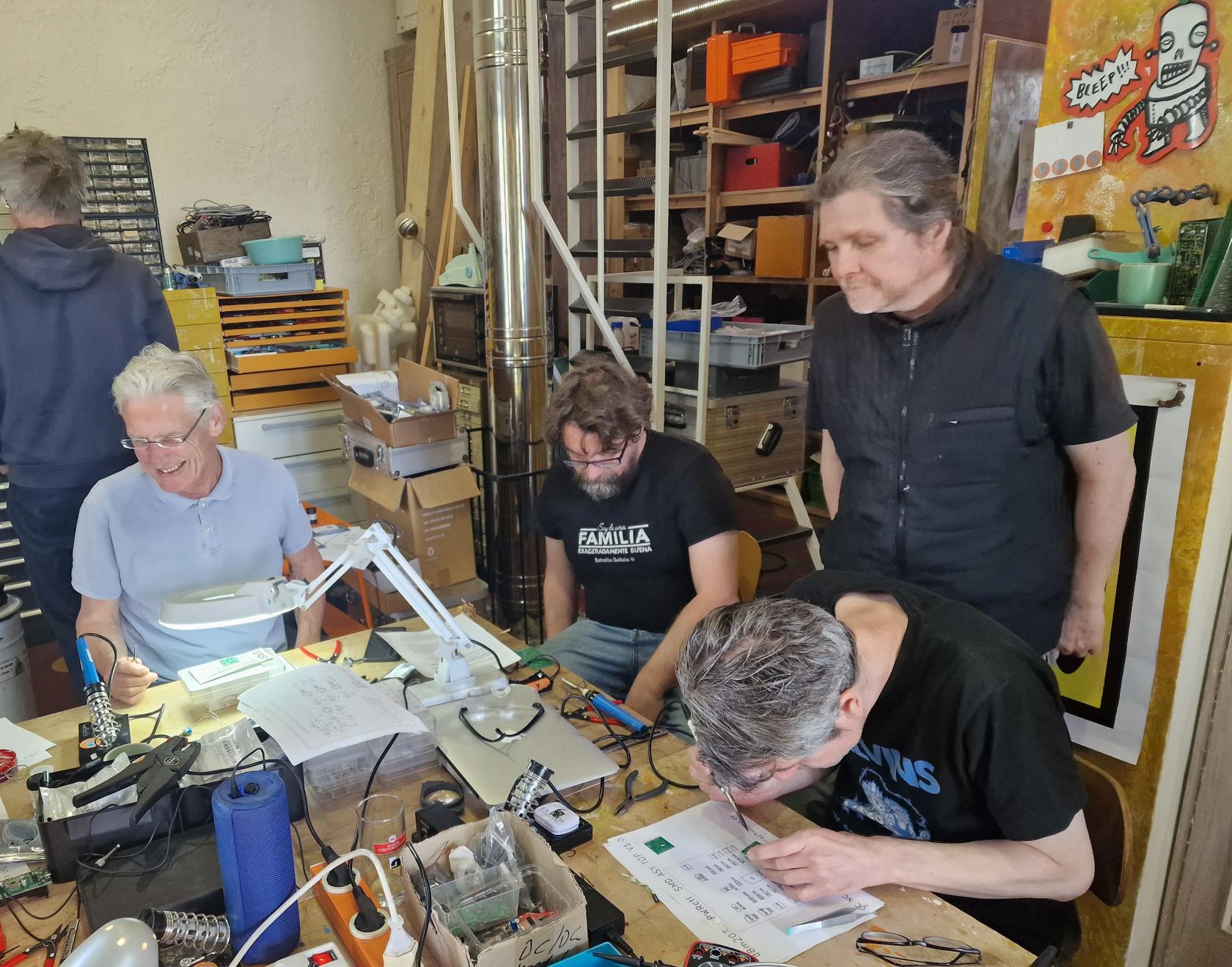
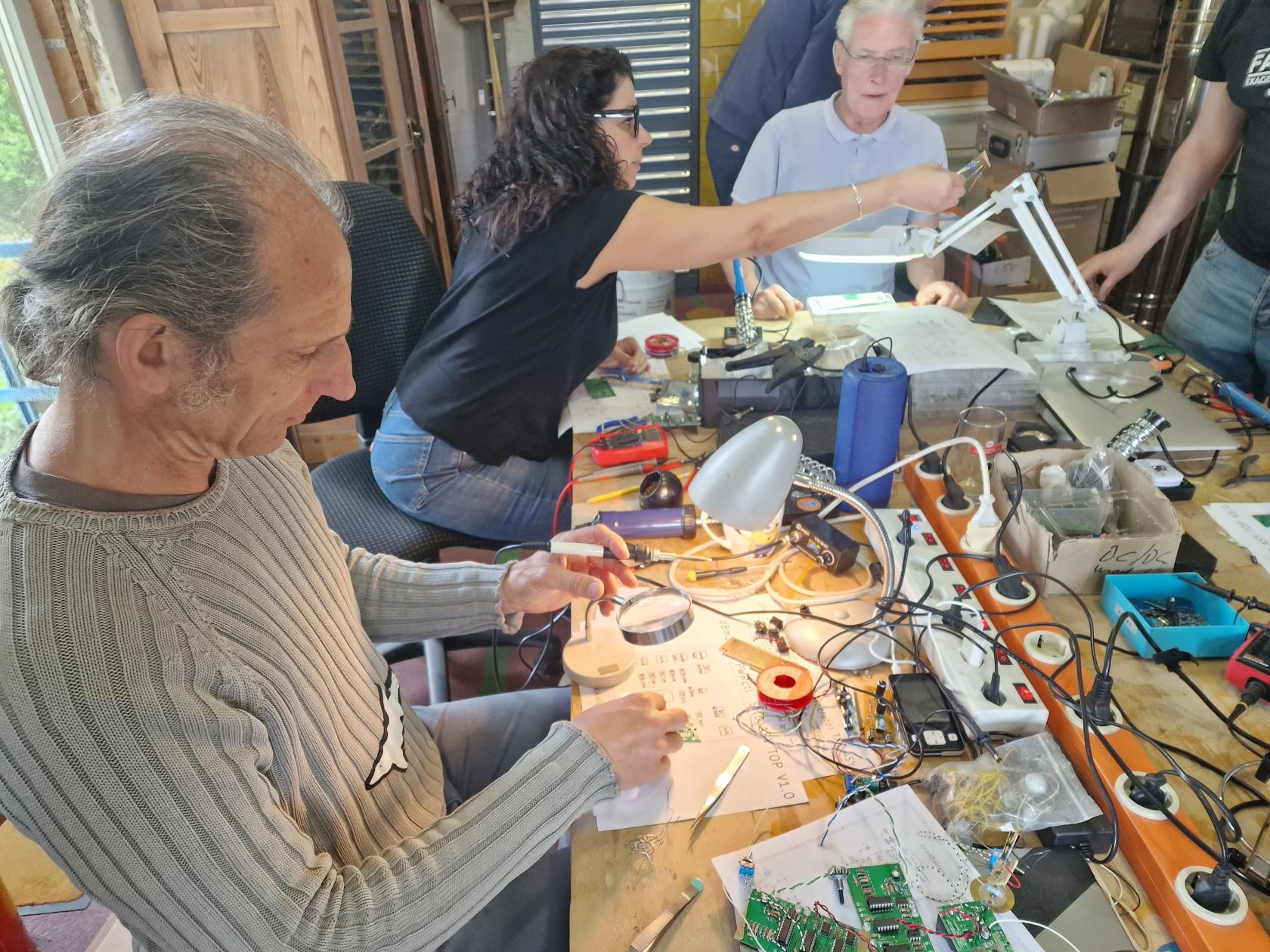
 **dBM 2026** is a DIY workshop festival for advanced <sup>\*) </sup>music electronic tinkerers where we will investigate the sonic limits of CMOS logic gate circuits. We want to delve deep into theory and practice and systematically develop, measure and optimize dBm circuits, so that at the end of the workshop the participants can take home a new dBm synth, or at least many ideas.

The workshop will take place near Tübingen, more precisely, 7km away in Dusslingen, right next to the train station in the [Kulturgüter-Schuppen](https://www.google.de/maps/place/Kulturg%C3%BCter-Schuppen/@48.4518194,9.0612137,806m/data=!3m1!1e3!4m6!3m5!1s0x4799fa17595b32f5:0x994f97e5c083f828!8m2!3d48.453264!4d9.057552!16s%2Fg%2F1tx1s4p3?entry=ttu&g_ep=EgoyMDI1MDIyNi4xIKXMDSoASAFQAw%3D%3D). There is an electronics workshop with lots of, mostly free, material, as well as a laser cutter and other tools.  
Accomodation will be in the local[ YMCA house](https://www.google.de/maps/place/CVJM+Du%C3%9Flingen+-+Stockach/@48.4524926,9.0639262,403m/data=!3m1!1e3!4m14!1m7!3m6!1s0x4799fa17595b32f5:0x994f97e5c083f828!2sKulturg%C3%BCter-Schuppen!8m2!3d48.453264!4d9.057552!16s%2Fg%2F1tx1s4p3!3m5!1s0x4799fa0fedee1cdb:0x8f58c3446a5e7d01!8m2!3d48.4529737!4d9.0661904!16s%2Fg%2F11c1wxbhjf?entry=ttu&g_ep=EgoyMDI1MDIyNi4xIKXMDSoASAFQAw%3D%3D), which is 15min walking distance. We can also use the [kitchen](https://www.cvjm-dusslingen.de/?page_id=298) there in the evening for self-catering.  
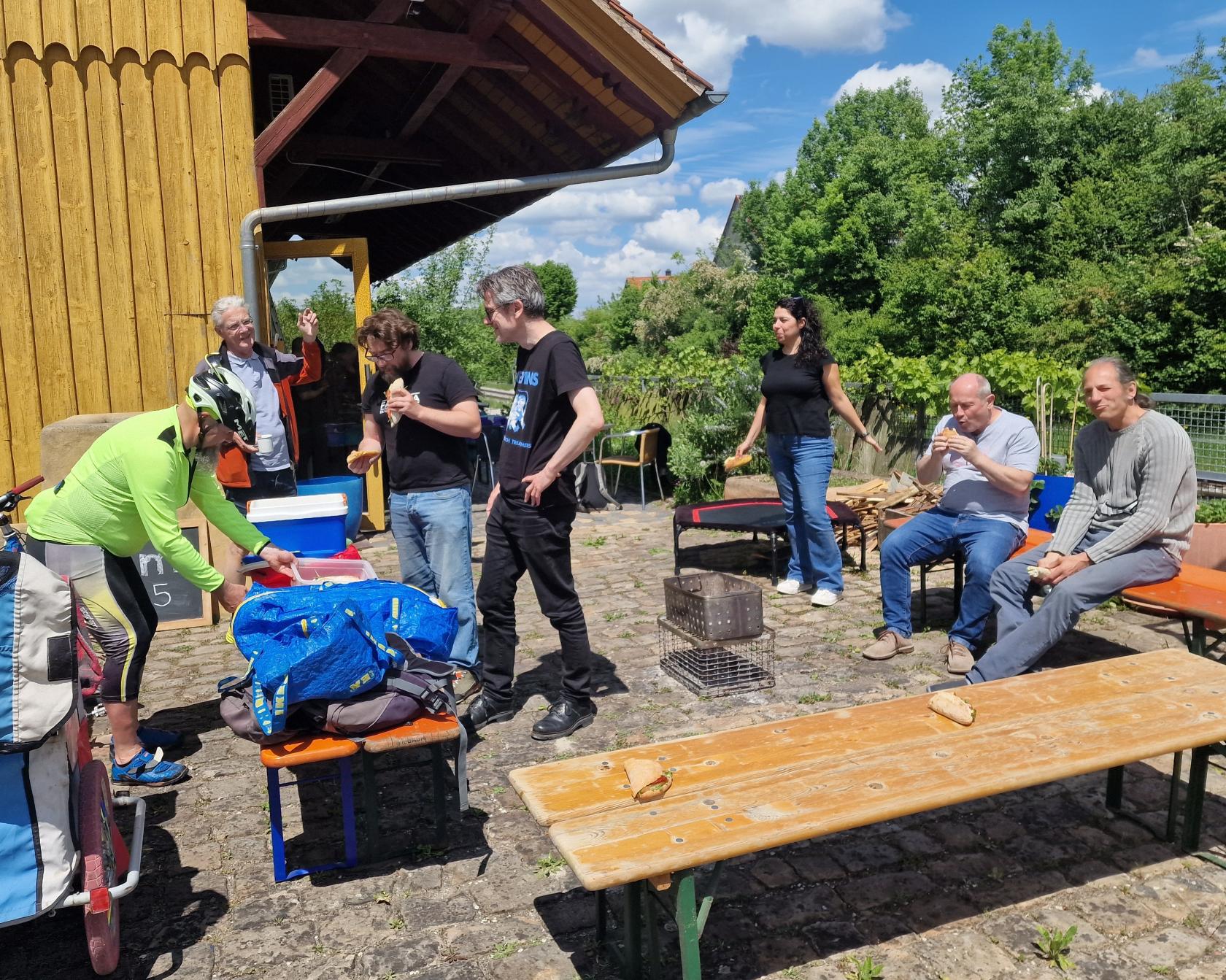
Drinks, fruit and something to nibble on will of course also be available during the day in the KulturGüterSchuppen. We plan a public concert on Saturday evening (23.May) at the end of the event, where we will present our “research results”.  
The costs for 4 overnight stays will be around 100€ per person. Cost of care depends on how often we want to cook ourselves.  
I will be able to give more details when the list of participants is complete.

If you would like to take part, please send a short description of what you do and what you would like to contribute technically and musically.  
Register as early as possible by email to kulturgueterschuppenÄTgooglemailDOTcom, as places are limited.

Note: Everything we develop together (schematics, hardware) is subject to the CC NC BY SA license. We develop for the DIY community!

  
\*) : advanced means: you can read a circuit diagram and put it on a breadboard, solder it on a breadboard or assemble a PCB without outside help.

# dBm 2026 program

during the 2nd. dBm festival we will proceed where we stopped last year.

# dBm 2025 program

#### building test hardware   


our dBm research system consists of these modules :

- Power supply : USB powered, LiPo battery, 5V out
- Power starving controller : voltage and current control with potentiometers &amp; CV inputs
- CMOS oscillator (D.U.T.) : various topologies of Schmitt-Trigger based squarewave oscillators
- High impedance buffer &amp; amplifiers: line and feedback outputs Potentiometers for gain and feedback
- C-multiplier: electronically variable capacitance with potentiometer and CV control. Acts as capacitive load for D.U.T.
- triple CV out pseudo random pattern generator : for controlling CVs of power staving controller and C-multipliers
- vactrol module : DIY dual vactrol with exponential CV control for potentiometer replacement in D.U.T.

##### overview experimental dBm setup

[![overview_modules.jpg](https://www.kulturgueter-schuppen.de/uploads/images/gallery/2025-05/scaled-1680-/overview-modules.jpg)](https://www.kulturgueter-schuppen.de/uploads/images/gallery/2025-05/overview-modules.jpg)

##### module details

WARNING : following schematics , layouts and documentation is WORK IN PROGRESS. Expect many changes during dBm 2025 week !

# chaosz

**chaosz** is the Kulturgüter-Schuppen classic of dBm instruments. It was created in 2010 at the first [Circuit Control Festival Dresden](https://www.circuit-control.de/) in the legendary Ostpol location. CHAOSZ (CHAOtic OSZillator), is a simple astable CMOS oscillator that can be made chaotic by power starving and variable filtering of the power supply. The sound ranges from a boring square wave to stomping locomotives to clucking chickens...

[![ChaosZzigar2.JPG](https://www.kulturgueter-schuppen.de/uploads/images/gallery/2025-03/scaled-1680-/chaoszzigar2.JPG)](https://www.kulturgueter-schuppen.de/uploads/images/gallery/2025-03/chaoszzigar2.JPG)  
[![Chaosz2010_SCH.jpg](https://www.kulturgueter-schuppen.de/uploads/images/gallery/2025-03/scaled-1680-/chaosz2010-sch.jpg)](https://www.kulturgueter-schuppen.de/uploads/images/gallery/2025-03/chaosz2010-sch.jpg)

**chaosz schematics** Version 2011: touch body contacts (BC) and output clipping to preserve the hearing of the remaining ear ;-)

[download chaosz .mp3 example](https://www.kulturgueter-schuppen.de/attachments/8 "chaosz sound")

##### **CHAOSZ FAQ**

**why this exotic CD4085 chip ?** because I got some hundred of them for free. You can use almost any CMOS gate connected as inverter in this circuit

**what's this Bruce Willis "die hard" capacitor ?**  
it creates a "power starving" envelope after switching off chaosz

# McMOS handbook 1973 - the bible for Lunetta style music electronics

After more than 50 years, the original Motorola manual from 1973 is still the most important source for CMOS4000 designs.  
It is so important for the music electronics engineer because, in addition to the digital possibilities of the 4000 CMOS logic, it describes the analog applications in great detail. Fortunately, I have owned the original edition to this day. Until today, because I decided to destructively scan the book, which cannot be found as a PDF on the Internet, to allow it to survive digitally, because my original is slowly decaying after decades of use. So you can download it here for private use :-)

[![McMOS_Handbook_1973_cover.jpg](https://www.kulturgueter-schuppen.de/uploads/images/gallery/2025-03/scaled-1680-/mcmos-handbook-1973-cover.jpg)](https://electro-music.com/forum/phpbb-files/mcmos_handbook_1973_149.pdf "McMOS handbook 1973")