# Light Art

# Nervous LEDman

![LEDMAN.jpg](https://www.kulturgueter-schuppen.de/uploads/images/gallery/2024-10/scaled-1680-/ledman.jpg)A small analog, interactive light object that responds to sounds and vibrations by flashing a LED.  
It's very sensitive, and reacts on human voice over a distance of 3m or more, when put on the right surface, e.g. a wooden table, box or anything that vibrates.

**Nervous LEDMAN** consists of 3 parts : ( top down )

**1) battery holder &amp; power switch**  
I use a [LilyPad coin battery holder](https://www.sparkfun.com/products/13883) or compatible and a rechargable LIR2032 battery

**2) LEDMAN PCB**  
It's a redesign of a [circuit by Yair Reshef .](https://www.youtube.com/watch?v=rnM_7NyU4k8)  
The original design uses an obsolete opamp and needs 2 batteries for 6V supply. Now it runs with a single cell and uses a cheap CMOS opamp <sup>\*)</sup> + 3 resistors + 1 ceramic capacitor in "beginner friendly" sized SMD packages (1206)  
<sup>\*)</sup> many SOT23-5 CMOS opamps, output @ pin 4, tested

**3) piezo disc sensor**  
this is a common 35mm diameter Piezo sounder/buzzer/speaker/drum sensor. Smaller discs are not recommended until you put LEDMAN straight on a loudspeaker box ;-)

the picture shows the "elektro kitsch" (C) version with vintage power resistors as legs and arms. A flexible 38mm, 3V LED filament is used as LED.

**construction notes :**  
resistor "arms" can be 0...10 Ohm, any wattage.  
resistor "legs" can be 0...100 Ohm, any wattage.  
LilyPad connection is a bit tricky : the red "+" wire is soldered straight to a LilyPad "+" pin. The black "-" wire tunnels the other LilyPad "+" pin without connection ( it must be isolated) and is soldered to LilyPad "-" pin on the rear side.  
The reason is: if you solder a wire to one of LilyPads "-" pins on the battery side, the battery can't be removed anymore !

**documentation :**

[NervousLEDman Schematics (PDF)](https://www.kulturgueter-schuppen.de/attachments/7 "NervousLEDman Schematics (PDF)")

[NervousLEDman PCB Layout ( PDF, 24pcs. 100x160mm single sided)](https://www.kulturgueter-schuppen.de/attachments/9 "NervousLEDman PCB Layout")

[NervousLEDman SMD assembly (PDF)](https://www.kulturgueter-schuppen.de/attachments/6 "NervousLEDman SMD assembly")

credits go to my friend Yair Reshef and unknown early developers for inspiration  
and Leah Buechley for LilyPad  
respect CC NC BY SA

# VolxTV

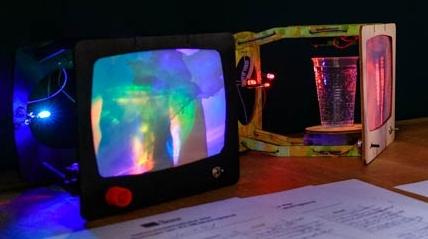
VolxTV is an analogue colour shadow projector, conceived as a replacement for the television set in the home. Its political message is: throw away your TV, build one yourself, and create your own programming to go with it.

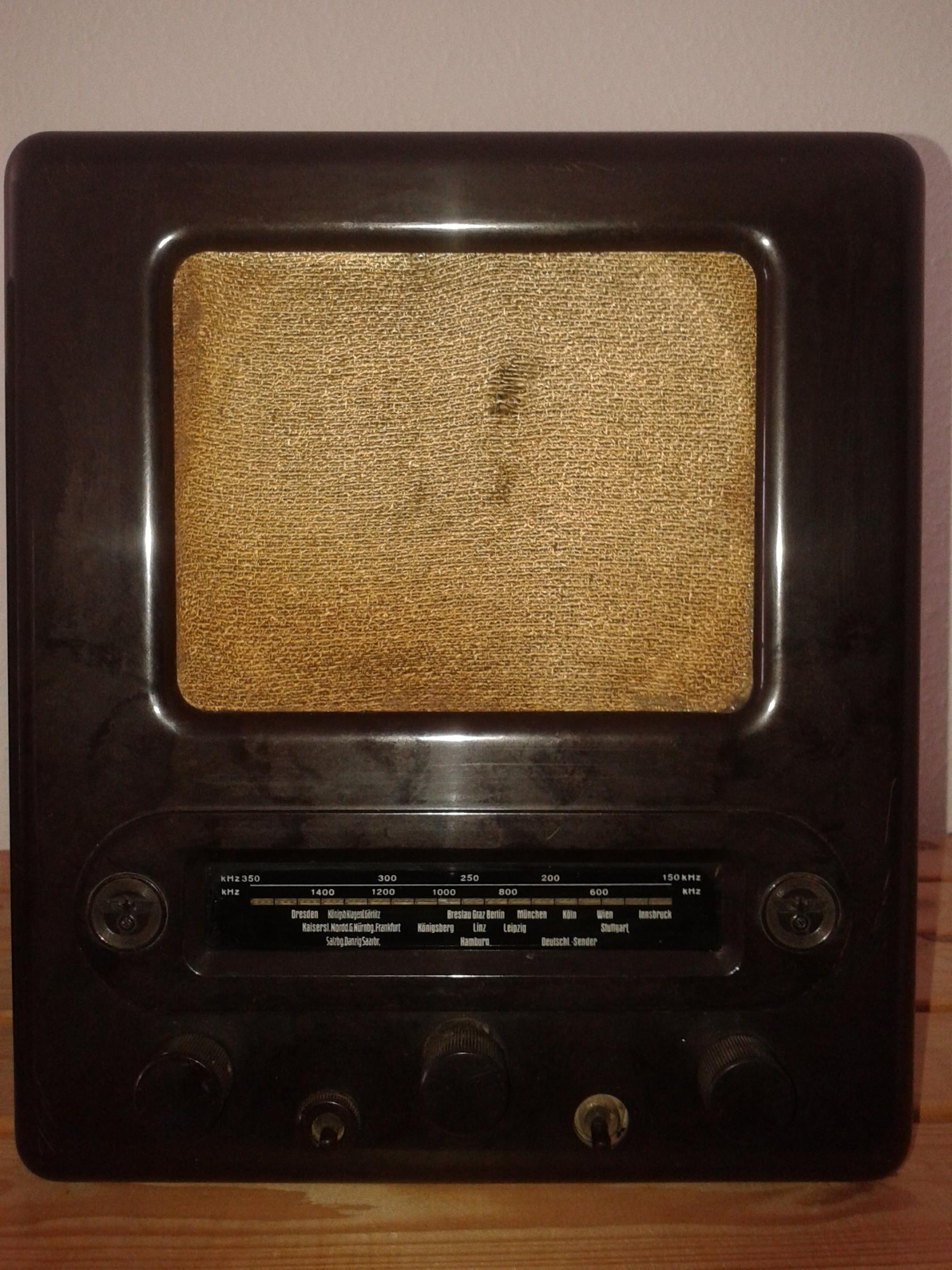
The name VolxTV refers to the *Volksempfänger* (“people’s radio”) used in Nazi Germany. Cheaply mass-produced, it was intended to bring Nazi propaganda into every household.

VolxTV, however, is not mass-produced. You have to build the device yourself and create the programming yourself in order to escape the consumer propaganda of television broadcasters.

<table id="bkmrk-%C2%A02%C2%A0-volxtv-%40-maker-f" style="border-collapse:collapse;width:100%;"><colgroup><col style="width:68.1677%;"></col><col style="width:31.8304%;"></col></colgroup><tbody><tr><td>[![Maker Faire TÜ 2025_Uwe&VolxTV®Fotostudio Ale Zea_ausschnitt.jpg](https://www.kulturgueter-schuppen.de/uploads/images/gallery/2026-10/scaled-1680-/maker-faire-tu-2025-uwevolxtvfotostudio-ale-zea-ausschnitt.jpg)](https://www.kulturgueter-schuppen.de/uploads/images/gallery/2026-10/maker-faire-tu-2025-uwevolxtvfotostudio-ale-zea-ausschnitt.jpg)</td><td>[![VE301_dyn.jpg](https://www.kulturgueter-schuppen.de/uploads/images/gallery/2026-10/scaled-1680-/ve301-dyn.jpg)](https://www.kulturgueter-schuppen.de/uploads/images/gallery/2026-10/ve301-dyn.jpg)</td></tr><tr><td> 2 VolxTV @ maker fair 2025 in Tübingen \[credits: Fotostudio Ale Zea\]</td><td>3rd Reich Volksempfänger</td></tr></tbody></table>

The operating principle is simple: two or more colour-changing LEDs illuminate an object placed on a turntable. The projection is displayed on a screen. Its shape is reminiscent of the old tube televisions of the 1950s to the 1970s. The VolxTV kit is made from 4 mm plywood in DIN A4 format and is laser-cut.  
The current version (2026) is no longer battery-powered but is powered via USB-C, either from a mains adapter or a power bank. The speed of the turntable can be adjusted on the front panel. The colour effects are created using “slow rainbow RGB LEDs.”

VolxTV is the best-known light art project of the Kulturgüter-Schuppen. Since 2011, workshops have been held repeatedly throughout Germany, Austria,Switzerland and Spain. More than 100 VolxTV units have been built to date.

<table id="bkmrk--2" style="border-collapse:collapse;width:100%;height:396.367px;"><colgroup><col style="width:50%;"></col><col style="width:50%;"></col></colgroup><tbody><tr style="height:332.567px;"><td style="height:332.567px;">[![Linz12_VolxTV2.jpg](https://www.kulturgueter-schuppen.de/uploads/images/gallery/2026-10/scaled-1680-/linz12-volxtv2.jpg)](https://www.kulturgueter-schuppen.de/uploads/images/gallery/2026-10/linz12-volxtv2.jpg)</td><td style="height:332.567px;">  
</td></tr><tr style="height:63.8px;"><td style="height:63.8px;">  
</td><td style="height:63.8px;">  
</td></tr></tbody></table>